Returning to Work After Motherhood: A Step-by-Step Plan

Returning to Work After Motherhood: A Realistic, Step-by-Step Path Back
Returning to paid work after time at home can bring excitement, uncertainty, and a long list of practical questions. The easiest way to make it feel doable is to treat it like a transition with phases—clarity first, then skill refresh, childcare planning, job searching, and a steady first 90 days—so your comeback is sustainable, not exhausting.
Start With a Clear Picture of What “Work” Needs to Look Like Now
Before updating a resume or applying anywhere, get specific about what your household needs today. That clarity prevents you from chasing roles that look good on paper but collapse under real-life scheduling.
- Define current priorities: income target, flexibility, commute limits, benefits, and long-term growth.
- Choose a work style that fits logistics: full-time, part-time, contract, seasonal, remote, hybrid, or return-to-office.
- Separate non-negotiables from nice-to-haves: predictable hours might matter more than a higher salary right now (or vice versa).
- Set a re-entry timeline: 2 weeks (quick return), 1–3 months (structured search), or 3–6 months (re-skill + search).
- Create a simple support map: list who can help with pickups, sick days, and backup care.
Turn Motherhood Experience Into Career Strengths (Without Overexplaining)
Hiring managers don’t need a long defense of your career break; they need evidence that you can solve problems. The most helpful move is translating what you’ve done into business language—briefly and confidently.
- Translate responsibilities into skills: planning, budgeting, conflict resolution, teaching/coaching, scheduling, and crisis management.
- Collect proof points: volunteer work, school committees, coordinating care, community leadership, or personal projects completed during your break.
- Use a one-sentence explanation: “I took time away for family caregiving and I’m excited to return to [role] where I can contribute in [strength].”
- Update LinkedIn for direction: a headline and summary that highlight your target role, strengths, and tools—rather than focusing on time away.
- Build a wins list: 6–10 short Situation–Action–Result stories you can pull from quickly in interviews.
Refresh Skills Efficiently (Pick One Lane and Go Deep)
Instead of trying to “catch up” on everything at once, focus on one lane that shows up repeatedly in your target job listings. Depth beats scattered effort—especially with limited time.
- Scan 10–20 postings and highlight recurring tools, certifications, and responsibilities.
- Pick one upskilling track: Excel/Google Sheets reporting, customer success tools, bookkeeping software, project management, or basic data literacy.
- Choose short courses with an output: a sample report, a project plan, a simple website, or a documented process.
- Do a “return-to-work” project: solve a real problem for a community group or small business to create recent experience and references.
- Use a steady cadence: three 45-minute sessions per week is more sustainable than occasional marathon days.
Build a Practical Plan for Childcare, School Schedules, and Backup Coverage
Most “back to work” stress isn’t the job itself—it’s the coverage gaps. Map the week honestly, then decide what care structure (and backup) makes your plan resilient.
- Map the week: work hours + commute + transitions + meal prep + bedtime to find the true coverage gap.
- Compare options realistically: daycare, nanny share, after-school programs, family support, sitter network, or staggered schedules with a partner.
- Plan for disruptions now: sick days, school closures, and last-minute meetings go from “rare” to “constant” fast.
- Clarify division of labor: mornings, pickups, appointments, and the unexpected.
- Keep communication lightweight: simple check-ins with caregivers reduce daily friction.
Childcare Planning Snapshot
| Option | Best for | Trade-offs to plan for | Backup idea |
|---|---|---|---|
| Daycare | Predictable full workdays | Waitlists, illness policies, fixed pickup times | A sitter on call for sick days |
| Nanny / babysitter | Custom schedules, younger kids | Higher cost, coverage if caregiver is out | Secondary sitter or family support |
| After-school program | School-age kids with later pickup needs | Holiday closures, limited spots | Neighbor carpool or rotating pickup plan |
| Family support | Lower cost and familiar care | Boundaries, availability changes | One paid option as a fallback |
Update Your Resume and Online Presence for a Confident Comeback
Job Search Strategy That Fits Limited Time and Energy
For workplace protections and boundaries, it can help to review authoritative guidance like the U.S. Department of Labor’s FMLA overview and the EEOC’s pregnancy discrimination resources. If you’re rebuilding confidence after a break, research and practical perspectives from Harvard Business Review can also be useful.
Your First 90 Days Back: Make It Sustainable
A Supportive Next Step
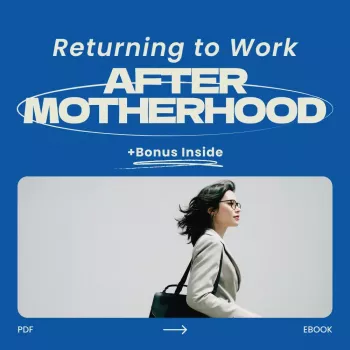
If you want structure without overwhelm, a guided roadmap can keep you moving one step at a time. The digital guide Returning to Work After Motherhood: Your Ultimate Guide for Stay-at-Home Moms is designed to help you track decisions, rebuild confidence, and follow a realistic sequence—clarity, skills, childcare, job search, and your first 90 days.
If you’re using AI tools to speed up applications, interview prep, or role research, Boost Your AI Prompts for Better Output – Checklist for Creators, Coaches & Entrepreneurs can help you get cleaner drafts and more useful outputs with less trial-and-error.
FAQ
How do stay-at-home moms explain a gap in employment?
Use one confident sentence that acknowledges caregiving and pivots to readiness for the target role. Then reinforce it with relevant skills, a recent project or volunteer proof point, and a clear direction for what you want next.
What is the best job for a mom returning to work?
The best job is the one that matches your schedule needs, income goals, and strengths while offering predictable logistics. Compare flexibility, benefits, growth, and stability, then shortlist roles that fit your current non-negotiables.
How can returning to work feel less overwhelming?
Break the transition into phases (clarity, skills refresh, childcare plan, job search, first 90 days) and set small weekly goals. Having backup childcare and simplifying home routines reduces last-minute stress dramatically.















Leave a comment